From telecom to AI, robotics and space, Ashok Jhunjhunwala is building India’s deep-tech ecosystem by turning impossible problems into opportunities.
 Rashmeet Kaur Chawla
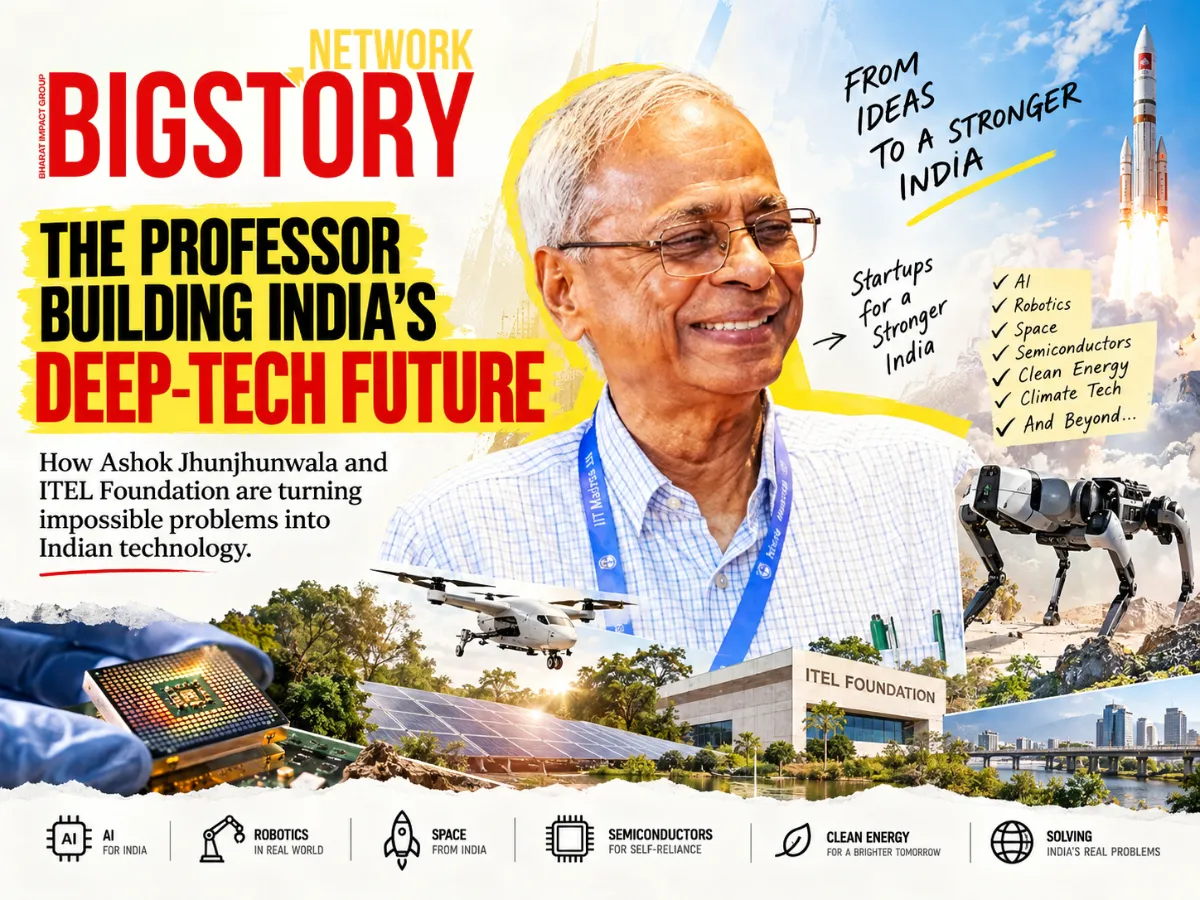
India's startup story has often been told through valuations, funding rounds and unicorns.
But beneath that familiar narrative, another India is being built.
It is an India working on technologies that are difficult to build, expensive to test and sometimes impossible to explain in a three-minute pitch deck.
Robotics that can move through terrain designed for humans but not machines. AI that can run at the edge. Rocket propulsion systems designed in India. Lithography machines needed to manufacture advanced chips. Technologies that can predict urban flooding. Machines that can separate mountains of municipal waste. Power electronics for the energy transition.
This is the world of deep technology and increasingly, it is becoming one of the most consequential parts of India's innovation story.
At the centre of one of India's most unusual deep-tech ecosystems is a man who has spent more than four decades working at the intersection of technology, academia, entrepreneurship and national development: Prof. Ashok Jhunjhunwala.
Jhunjhunwala.webp)
Today, as Chairman of Immersive Technology and Entrepreneurship Labs (ITEL) Foundation, Jhunjhunwala is working on a proposition considerably larger than building individual startups: making India a technology leader by solving its own seemingly impossible problems.
Jhunjhunwala's story begins well before the current Indian startup boom.
After graduating in Electrical Engineering from IIT Kanpur in 1975 and earning his Master's and PhD from the University of Maine, he began his academic career in the United States.
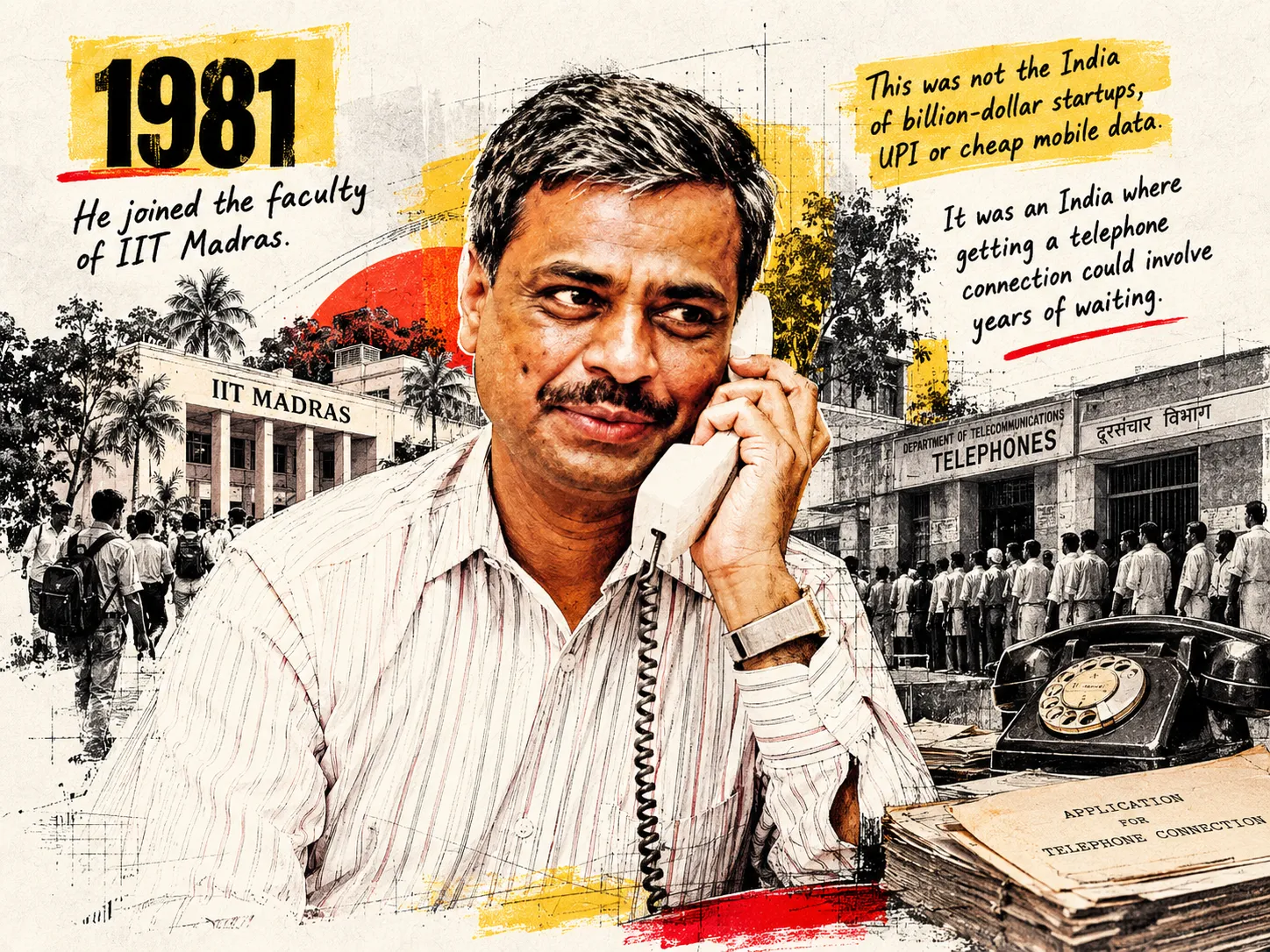
In 1981, he joined the faculty of IIT Madras.
This was not the India of billion-dollar startups, UPI or cheap mobile data. It was an India where getting a telephone connection could involve years of waiting.
Jhunjhunwala's response to such problems was not to accept them as inevitable. It was to ask whether technology could change the economics behind them.
That question became a recurring theme throughout his career.
Through the TeNeT Group, he helped develop affordable, India-oriented technologies spanning telecommunications, banking, renewable energy, healthcare and electric mobility. His work included Wireless in Local Loop, affordable ATMs, solar-DC systems and electric mobility solutions.
The pattern is important. Jhunjhunwala was not simply interested in inventing technology. He was interested in making technology useful at India's scale and price points.
That distinction would later become central to the deep-tech ecosystem he helped build.
Perhaps Jhunjhunwala's greatest contribution is not one invention. It is the infrastructure he helped create for other people to invent.
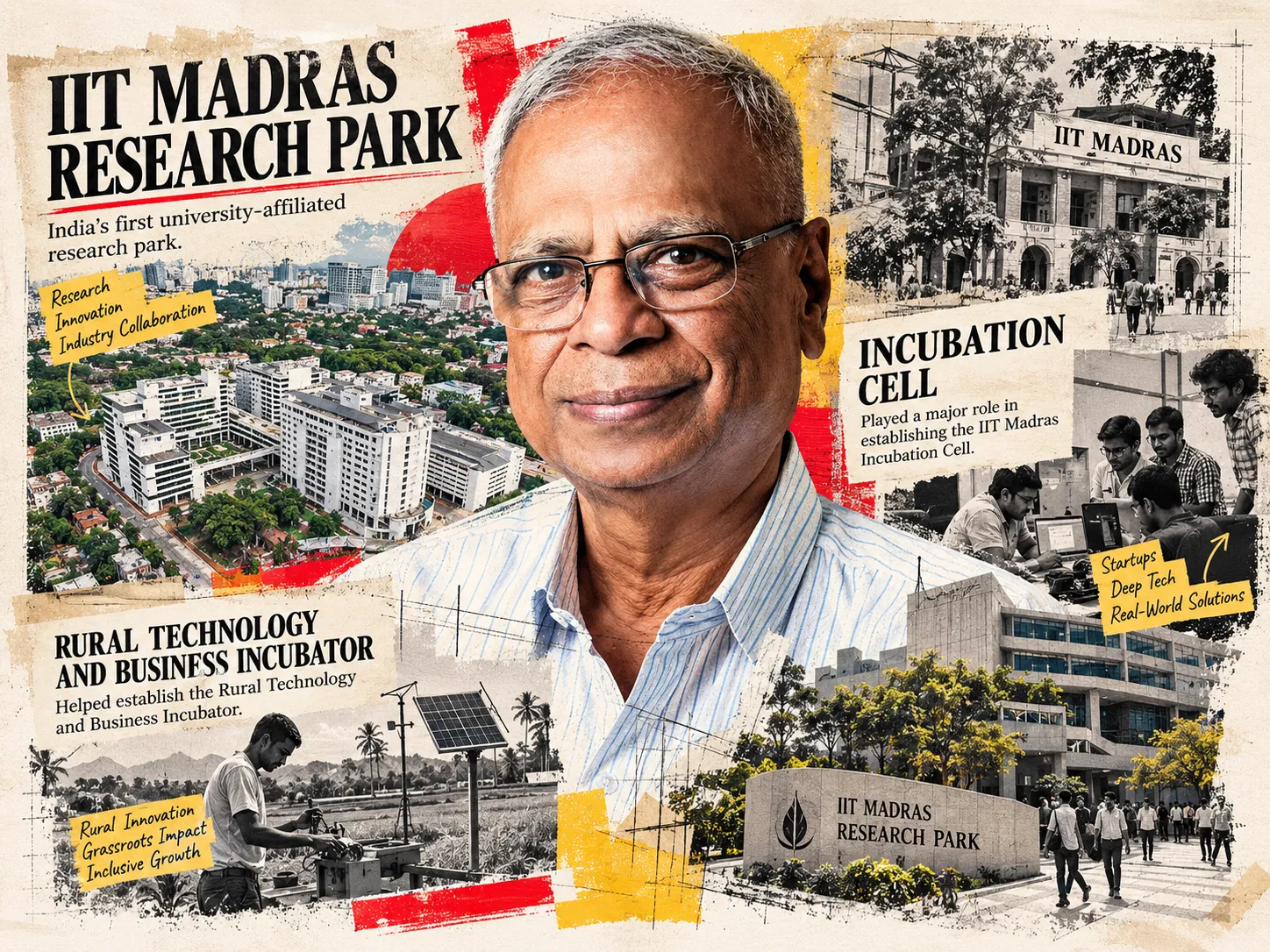
He was a founding force behind the IIT Madras Research Park, India's first university-affiliated research park, and played a major role in establishing the IIT Madras Incubation Cell and Rural Technology and Business Incubator.
Across these institutions, he has helped nurture more than 350 startups.
That number matters because deep-tech companies do not behave like conventional software startups. A software company can potentially build an MVP in months. A semiconductor startup may need years of R&D. A robotics company needs hardware, testing environments, mechanical engineering, control systems and manufacturing. A space company must deal with propulsion, materials, testing and extreme reliability.
The incubation model therefore has to be different.
Jhunjhunwala's philosophy has increasingly been built around exactly that problem: founders need technical mentorship, infrastructure, networks, patience and the discipline to keep iterating.
An incubator is not merely supposed to give a startup money, an office and a logo on its website. It has to help build the founder.
Immersive Technology and Entrepreneurship Labs (ITEL) Foundation is a Section 8 not-for-profit built around a deceptively simple question: Why can't India solve its own hardest problems?
ITEL describes itself as a convergence point where scientists, startups, innovators and young technologists can work together on problems that appear almost impossible.
Its incubation portfolio currently lists 40+ startups across 15+ deep-tech domains, including artificial intelligence, robotics, space technology, semiconductors, climate technology, power electronics, clean energy, advanced materials, medical technology and industrial technology.
But ITEL's more interesting contribution is its philosophy.
Instead of beginning with, 'What technology can we build?', the ecosystem frequently begins with, 'What problem is so difficult that nobody has solved it properly yet?'
That changes everything.
VibeStudio works on AI-powered coding and agentic software development. ITEL has highlighted work on model compression and pruning aimed at making advanced AI more deployable on smaller hardware. The larger opportunity is important: if useful AI can run efficiently on local or edge hardware, advanced intelligence becomes more accessible and less dependent on enormous compute infrastructure.
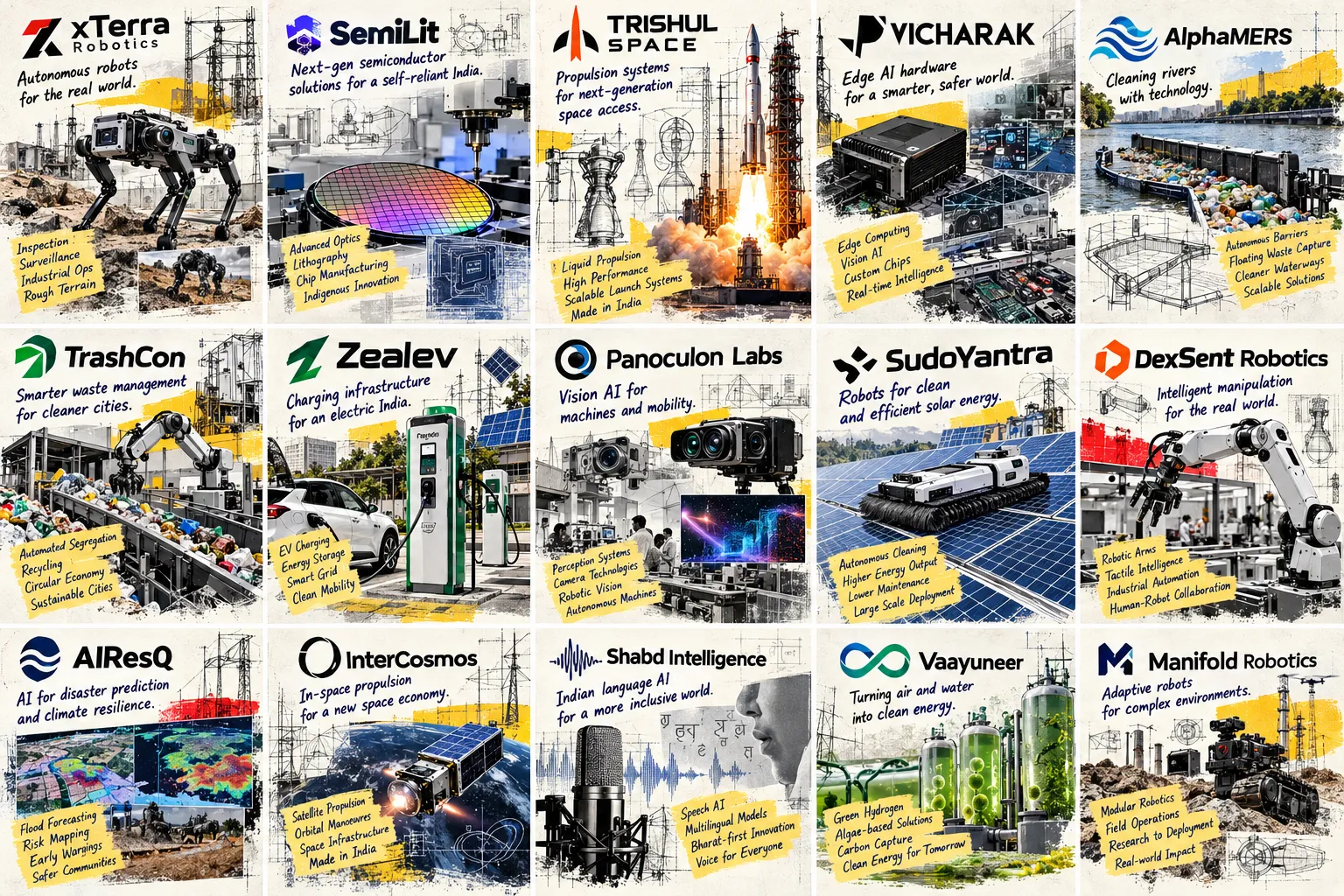
xTerra Robotics develops quadruped and legged robotic platforms for demanding environments. Its SVAN M2 is positioned as a commercial quadruped, while SCORP combines legged mobility with a robotic arm. The company is solving a fundamental physical-AI problem: enabling machines to move, sense and operate across unstructured terrain.
InterCosmos is developing in-space propulsion technology, including its HyperX platform. Space propulsion is a difficult engineering layer where reliability, performance, materials and testing all matter. ITEL’s role is significant because a young propulsion company needs more than capital: it needs technical mentorship, credibility, networks and patience.
Trishul Space is developing indigenous liquid rocket propulsion systems, including the Harpy-1 engine. Its mission is to simplify launch-vehicle development with ready-to-integrate propulsion systems. The company illustrates why patient deep-tech incubation matters: propulsion requires years of engineering, testing and iteration before commercial success becomes visible.
SemiLit is building DUV immersion lithography machines using an approximately 193nm ArF light source, targeting 28nm-or-better resolution. Its long-term ambition includes EUV lithography. The company tackles one of the semiconductor industry's most difficult equipment problems: making advanced chip manufacturing infrastructure more accessible and developing strategic capabilities within India.
Vicharak is building reconfigurable computing platforms and edge-AI hardware. Its products include the Vaaman reconfigurable edge computer and Axon AI single-board computers. The company is challenging conventional computing architectures by bringing reconfigurability closer to the user and enabling hardware acceleration for AI, robotics and other demanding workloads.
Shabd Intelligence is working on AI-driven language technologies for Indian users, including voice and text interfaces designed to make knowledge and communication more accessible. The deeper problem is inclusion: India's AI systems must work for people across its linguistic diversity, not only for users comfortable with globally dominant languages.
Panoculon Labs develops environment-perception systems for humans and machines. Its Trinet family synchronizes camera, motion and audio data for teams training vision-language-action models. This matters for physical AI because robots and intelligent systems need reliable, synchronized perception before they can act intelligently in the physical world.
AlphaMERS engineers riverine solid-waste systems, including floating trash barriers, sweeping boats and floating wetlands. The company says it has arrested 22,000 tonnes of debris in a single year and deployed barriers across Indian cities. Its work turns a huge environmental problem into an engineering and collection problem that can be attacked at scale.
TrashCon develops technology that automatically sorts unsegregated municipal solid waste. Its patented TrashBot is designed to separate waste into useful fractions with minimal human intervention, at capacities ranging from small facilities to city-scale plants. The company demonstrates how Indian operating conditions can demand purpose-built engineering rather than simply imported waste technologies.
SudoYantra develops outdoor robots for solar-panel cleaning. The opportunity is straightforward but important: as solar farms expand, cleaning and maintenance become large operational tasks. Automation can reduce manual work, improve consistency and help solar assets operate efficiently without relying on water-intensive cleaning methods.
Zealev designs power-conversion systems for battery energy storage, DC fast charging, microgrids and fuel cells. Its work sits beneath the visible EV and renewable-energy story: efficient power conversion is essential for moving electricity between batteries, grids, chargers and distributed energy systems.
Vaayuneer Sciences works on climate and energy technologies involving microalgae and hydrogen-related applications. The company represents the kind of cross-disciplinary work deep tech often requires, bringing biology, materials and energy engineering together around the challenge of reducing dependence on conventional fuels.
DexSent Robotics is developing intelligent robotic manipulation technology for industrial automation. Its ambition is to build industrial robotic capability from India for global markets. The company represents a crucial next step in India's manufacturing story: moving from automation consumption toward indigenous robotic systems and intellectual property.
AIResQ is associated with work on physics-informed AI for flood and waterlogging prediction, translating rainfall and river-discharge information into more localized risk intelligence. The larger goal is to help cities move from reacting to flooding toward predicting and managing it using data, modelling and engineering.
The portfolio is diverse: AI, robotics, space, semiconductors, climate, energy, healthcare and advanced materials. But there is a common thread.
ITEL is not trying to build another startup factory. It is trying to build a technology ecosystem around difficult problems.
ITEL says its incubation programme provides access to industry leaders, technologists from leading institutions, R&D facilities and training designed to develop the entrepreneurial mindset and discipline needed to scale ideas.
The organisation also works through consortia, bringing researchers, startups and industry together around problems such as urban mobility, waterlogging, climate resilience and waste.
This is essentially the philosophy Jhunjhunwala has spent decades building: solve the real problem, connect the right expertise and create an environment where the technology can survive the long journey from laboratory to deployment.
There is a temptation to measure a technology leader by the companies he founded. Jhunjhunwala presents a different model.
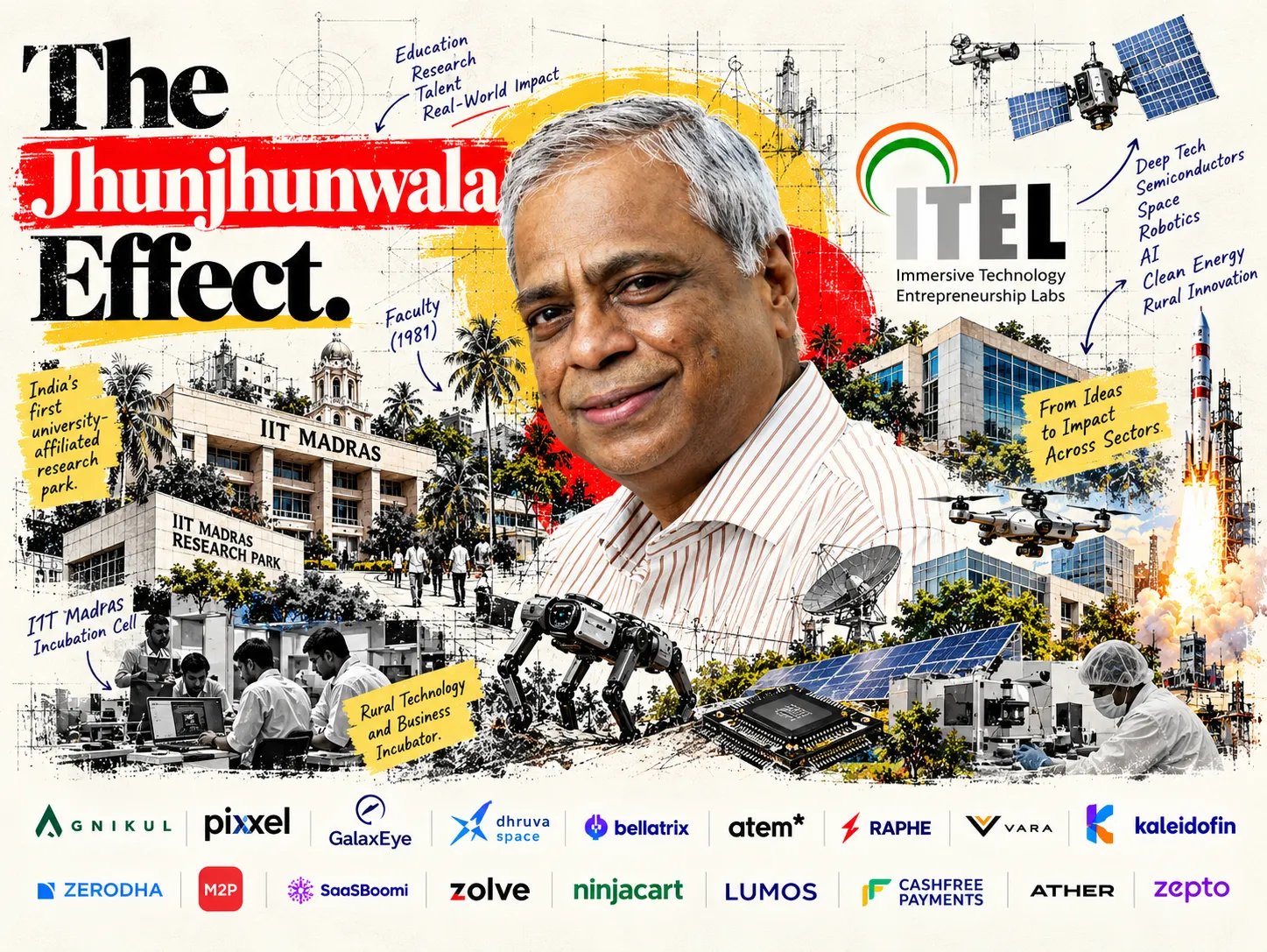
His most significant contribution may be the people and institutions he enabled.
He helped create the IIT Madras Research Park. He helped build IIT Madras's incubation ecosystem. He helped nurture more than 350 startups through the broader ecosystem associated with these institutions. He mentored generations of founders. And now, through ITEL, he is helping reproduce that model around a new generation of deep-tech problems.
That is why his role is particularly interesting.
He is not simply an entrepreneur. He is an ecosystem architect.
And perhaps more importantly, he appears to have retained the curiosity of an engineer while acquiring the patience of an institution builder.
His philosophy around startups is revealing: failure is not necessarily evidence that a founder should stop; sometimes it is part of the process through which a difficult technology becomes possible.
That attitude becomes especially valuable in deep tech because the hardest technologies cannot always be built on the timeline of a conventional venture-capital cycle.
India has become exceptionally good at providing services to the global economy. But Jhunjhunwala's vision goes further.
He has consistently argued that India must become a country that designs and builds technology, rather than remaining primarily an assembler or consumer of technologies created elsewhere.
That distinction is becoming increasingly important. AI infrastructure is strategic. Semiconductors are strategic. Energy storage is strategic. Space technology is strategic. Defence technology is strategic. Robotics is strategic. Advanced materials are strategic.
The countries that control these technologies will increasingly influence the economics and geopolitics of the next several decades.
India's path to technological sovereignty cannot depend entirely on importing the machines, software and intellectual property needed to build the future. It needs its own.
Perhaps the most admirable part of Jhunjhunwala's journey is not any particular award, startup or institution. It is the consistency of the underlying idea.
For decades, he has approached technology through a deceptively Indian question: Can we solve the problems that the world has largely ignored because they are too difficult, too expensive or too specific to India?
That thinking began with telecommunications. It moved into affordable banking, renewable energy, healthcare and mobility. It helped create the IIT Madras Research Park and a generation of technology entrepreneurs. And today, through ITEL, it is being applied to urban transportation, flooding, waste, climate, AI, robotics, space and advanced manufacturing.
The remarkable thing is that the ambition has grown without fundamentally changing.
Solve the real problem. Build the technology. Make it affordable. Make it scalable. Build it in India. And then make it good enough for the world.
That may ultimately be Jhunjhunwala's greatest contribution to Indian deep tech.
Not that he built every technology himself. But that he helped create an environment in which young Indians could attempt technologies that once seemed beyond India's reach.
ITEL's current portfolio 40+ startups across 15+ deep-tech domains and is still small compared with India's enormous startup ecosystem.
But perhaps that is the point.
Deep tech does not need thousands of companies chasing the same consumer trend. It needs a smaller number of teams willing to spend years solving difficult engineering problems.
It needs professors willing to mentor founders. It needs laboratories connected to industry. It needs patient capital. It needs institutions willing to tolerate failure. And it needs people who can see technological sovereignty not as a slogan, but as an engineering project.
Ashok Jhunjhunwala has spent much of his career building precisely that infrastructure.
Now, through ITEL, he is attempting to take the experiment to a much larger scale.
If the next decade produces Indian companies that build world-class robots, AI systems, semiconductor equipment, propulsion systems, climate technologies and advanced industrial platforms, their stories may eventually be told as individual startup successes.
But behind some of those stories, there may be another story worth remembering: the story of an IIT professor who spent decades building the ecosystem that gave those founders a chance.
And perhaps that is what makes Ashok Jhunjhunwala a true Challenger.
He has spent his career challenging a particularly persistent Indian assumption: that some problems are simply too difficult to solve here.
His answer has remained remarkably consistent.
"Try anyway".
The following sources were used to verify the article’s claims and provide readers with direct reference links. Official first-party sources are prioritized wherever available.
ITEL Foundation — Official website — https://itelfoundation.in/
ITEL Foundation — Incubation Portfolio — https://itelfoundation.in/incubatees-list.html
ITEL Foundation — Incubation Program — https://www.itelfoundation.in/incubatees.html
ITEL Foundation — Climate Tech initiatives — https://www.itelfoundation.in/climate-tech.html
ITEL Foundation — Assistive Technology — https://www.itelfoundation.in/assistive-technology.html
ITEL Foundation — Media & Reports — https://itelfoundation.in/Media.html
IIT Kanpur — Prof. Ashok Jhunjhunwala profile — https://www.iitk.ac.in/dora/profile/prof-ashok-jhunjhunwala
IIT Madras Research Park — Startup ecosystem — https://respark.iitm.ac.in/startups
IIT Madras Research Park — Startup directory — https://respark.iitm.ac.in/startup-directory
SemiLit — Official website — https://www.semilit.in/
Trishul Space — Official website — https://www.trishulspace.com/
xTerra Robotics — Official website — https://xterrarobotics.com/
Vicharak — Official website — https://vicharak.in/
Panoculon Labs — Official website — https://www.panoculonlabs.com/
AlphaMERS — Official website — https://alphamers.com/
TrashCon — Official website — https://trashcon.in/
Zealev — Official website — https://zealev.com/
DexSent Robotics — Official website — https://dexsentrobotics.com/
 Exclusive Content



Sign up for the Daily newsletter to get your biggest stories, handpicked for you each day.


 Trending Now! in last 24hrs